Land Value Capture: How Cities Finance Infrastructure with Value Uplift
What land value capture is, what instruments exist, and how they can finance urban infrastructure with value uplift in Mexico and Latin America.
The Money the City Creates but Never Collects
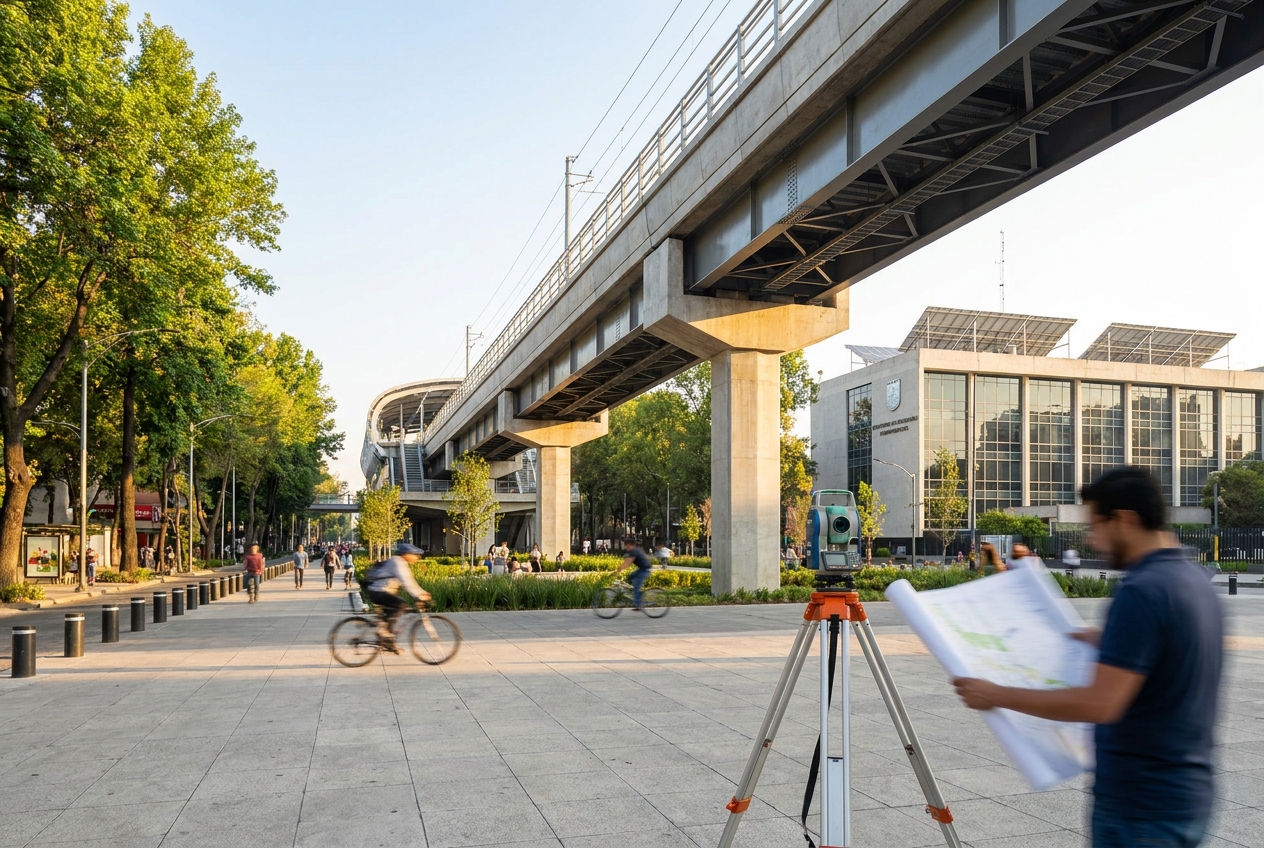
When a city builds a metro station, land within a 500-meter radius can increase in value by 15% to 40% in the first years of operation. That increase does not arise from the landowner's effort. It arises from collective investment: taxes, public debt, planning. Yet in most Latin American cities, that increase is automatically privatized, and the public treasury that financed the project recovers nothing of that appreciation.
The question that has gone without a structural answer for decades is this: if the state creates value, why can it not recover part of it to finance the next investment? Land value capture is precisely the technical answer to that question. It is neither a radical theory nor a new instrument. It is a public finance mechanism with a documented track record across four continents, and organizations such as the World Bank, the IDB, UN-Habitat, and the Lincoln Institute of Land Policy regard it as a central component of modern municipal finance.
What Land Value Capture Is
Land value capture is the set of fiscal, legal, and management instruments that allow the public sector to recover, in whole or in part, the value increases generated in private properties as a direct consequence of public decisions: land-use changes, infrastructure works, service provision, or densification authorized by urban regulation.
The concept has roots in classical economics. Adam Smith, John Stuart Mill, and Henry George argued, from different perspectives, that land rent is a form of value that society creates and that tends to concentrate in the hands of landowners who have not contributed to generating it. The modern version of the argument is more pragmatic: it is not about taxing property in the abstract, but about linking the fiscal contribution to the public decision that generated the value increase.
The accumulated lessons from Latin America show that capture instruments can finance between 20% and 40% of investment in urban infrastructure in contexts where they are designed with technical adequacy. That proportion makes value capture a strategic complement to the public budget, not a substitute.
Instruments: Three Families, Different Logics
Taxes on Land Value
The differentiated property tax is the most widely used instrument. When properly calibrated, it is also one of the most efficient: if the cadastral register is updated frequently and reflects the value increases associated with public action, the property tax continuously captures that differential without distorting the land supply. Unlike taxes on buildings, which penalize construction, the land value tax does not discourage productive investment: it taxes what the city did, not what the owner built.
The betterment levy (also called a special assessment) goes one step further: the owner of a property benefiting from a specific project pays a fee proportional to the cost of that work. The mechanism is explicit in its logic: the project is identified, the benefit area is defined, the cost is distributed, and the charge is directly linked to the verifiable improvement. In Colombia, the "participación en plusvalías" (value uplift participation) is a refined version: the municipality retains between 30% and 50% of the value increase produced by regulatory changes, and that charge is triggered at the moment of a transaction or building permit.
Direct Land Management Instruments
More sophisticated than taxes, these mechanisms combine territorial management with urban financing.
In Brazil, the "outorga onerosa do direito de construir" allows developers to acquire the right to build above the basic floor-area ratio by paying the municipality a price linked to the value generated. The Certificados de Potencial Adicional de Construcción (CEPACs) are their securitized version: São Paulo deployed them in urban operations such as Faria Lima to finance public infrastructure within the operation itself. Densification becomes a financing source.
Land readjustment is another high-efficiency mechanism: the owner cedes a fraction of their urbanized land in exchange for the public agency installing infrastructure. The owner retains a smaller plot by area but one of higher unit value; the municipality obtains land without forced expropriation. This instrument eliminates one of the greatest obstacles to urban development in Latin America: land acquisition for public works.
The public land bank operates on a longer time horizon: the public entity acquires land in advance (before announcing works), urbanizes it, and sells or leases it with the value uplift already incorporated. The financial differential is channeled into urban development funds for subsequent investment cycles.
Latin America: A Laboratory with Documented Results
Latin America's experience with value capture is the richest laboratory available for policy design. Bogotá is the most documented reference: the Colombian "contribución de valorización" financed the city's ring roads for decades, accumulating more than 1.5 billion dollars in works since the 1970s. The system has remained operational across multiple administrations thanks to its technical insulation: the contribution is assessed and executed within the same planning cycle, with a public audit of the link between charge and project.
A comparative analysis between Mexico City and Manizales, Colombia identifies a critical sustainability factor: the civic legitimacy of the instrument depends on public perception of where the funds go. When taxpayers verify the completed project and understand the link to their contribution, the litigation rate falls and revenue improves in subsequent cycles. When that traceability breaks down, the instrument erodes politically within two or three budget cycles. This is not a technical problem; it is an institutional design problem.
Medellín applied value capture mechanisms in its urban mobility projects, including the metrocable and the Ayacucho tram, where the revaluation of the immediate surroundings served as the basis for betterment charges that financed complementary facilities.
The Case of Mexico: Underutilized Potential
Mexico presents a regulatory paradox. Article 27 of the Constitution establishes that the nation may regulate the benefit generated by public action on private property. The 2016 General Law on Human Settlements, Territorial Planning, and Urban Development enshrines the principle of equitable distribution of costs and benefits of urban development. On paper, the legal framework is enabling.
However, a study on the viability of value uplift recovery in the municipality of Monterrey documents that the main obstacle is not legal but institutional: municipal cadastral registers are not updated frequently enough to reflect real value increases; treasury offices lack the technical capacity to design and collect special assessments; and the coordination between urban planning and public finance is weak or nonexistent in most municipalities.
The result is well known: municipalities finance infrastructure through debt (to be paid by future taxpayers) rather than through value uplift (to be paid by those who captured the value increase). The WRI's analysis of land management instruments adds an equity dimension: when value uplift is not recovered, the benefits of public spending concentrate in the owners of the best-located land, while the costs are socialized through general taxes. In metropolitan areas with high investment in mobility and infrastructure, that distributive effect is significant.
The Campeche State Congress explored the regulatory dimension of these mechanisms through its Value Uplift Recovery Workshop, a legislative exercise that illustrates the growing subnational interest in building the legal instruments needed to apply these mechanisms within the existing constitutional framework.
Conditions for Success
The comparative evidence, including the analysis of land value capture for metropolitan development, points to four conditions that determine whether an instrument succeeds or fails in practice.
Updated multipurpose cadastral register. Without a reliable valuation base, any instrument is exposed to legal challenge. Cadastral registers with continuous updating, at least annual, are a necessary condition. Cadastral lag in Mexico is one of the most documented fiscal problems and the one that most directly undermines municipal revenue capacity.
Explicit link between revenue and project. Captured funds must have a linked and verifiable destination. General-fund schemes without traceability erode legitimacy in the first application cycles.
Municipal technical capacity. Sophisticated instruments require specialized teams in valuation, urban law, and financial structuring. The capacity gap is the greatest constraint in medium and small cities, and it is where federal or state technical assistance can contribute most.
Gradual implementation. The Colombian and Brazilian experience shows that institutional credibility is built incrementally. Starting with a special assessment for a specific project, executing it well, rendering accounts, and using that experience to scale toward more complex mechanisms: that sequence has a better track record than comprehensive reforms designed in full and implemented halfway.
Toward a Constructive Agenda for Mexico
Land value capture is not a single formula or a universal solution. It is a family of tools whose effectiveness depends on design, institutional context, and management capacity. Its logic is sound: those who benefit from collective investment contribute to financing it.
For Mexico, a constructive agenda can be structured across three time horizons.
Short term: cadastral modernization with market valuation criteria in the main metropolitan municipalities, accompanied by technical assistance in mass appraisal methodologies. The well-calibrated property tax is already a capture instrument, albeit a limited one, and its improvement does not require new laws: it requires technical updating and institutional coordination.
Medium term: systematic incorporation of betterment levies into urban infrastructure projects in federal and state investment portfolios. Standardized technical guidelines to help municipalities design and administer these mechanisms with uniform criteria would reduce the heterogeneity that currently fragments practice and makes it vulnerable to litigation.
Long term: enabling more sophisticated instruments (urban operations, land readjustment, public land banking) in the metropolitan areas with the highest growth dynamics. This requires reforms to state urban development laws, strengthening of metropolitan agencies with a clear financial mandate, and transparency frameworks that make fund allocation traceable.
Sustainable urban financing does not arise from endless cycles of municipal debt or generalized increases in fiscal burden. It arises from designing the right instruments so that the city recovers part of the value it generates. Latin America already has working prototypes. The task is to scale them with technical rigor, adequate institutional design, and verifiable accountability.
---
Sources
- Implementing Value Capture in Latin America: Policies and Tools for Urban Development
- Lecciones aprendidas de la experiencia de América Latina con la recuperación de plusvalías
- Viabilidad de la recuperación de plusvalías en México: el caso del municipio de Monterrey
- La plusvalía como sistema de financiación urbana: estudio comparativo en Ciudad de México y Manizales, Colombia
- Captura del valor del suelo para la planificación urbana: aspectos claves para el desarrollo metropolitano
- Instrumentos de gestión de suelo: una estrategia para financiar el desarrollo urbano
- Taller Recuperación de Plusvalías