From "Made in Mexico" to "Made by Mexico": Building Mexico's New Solar Energy Sovereignty
A new legal framework and a renewed vision for energy development give Mexico the foundation to leap from manufacturing platform to industrial powerhouse. The global solar industry is at an inflection point. As the United States redefines its industrial policy amid a shifting domestic landscape and China consolidates its technological dominance across critical value chains, Mexico has a historic opportunity, not merely to integrate, but to lead.
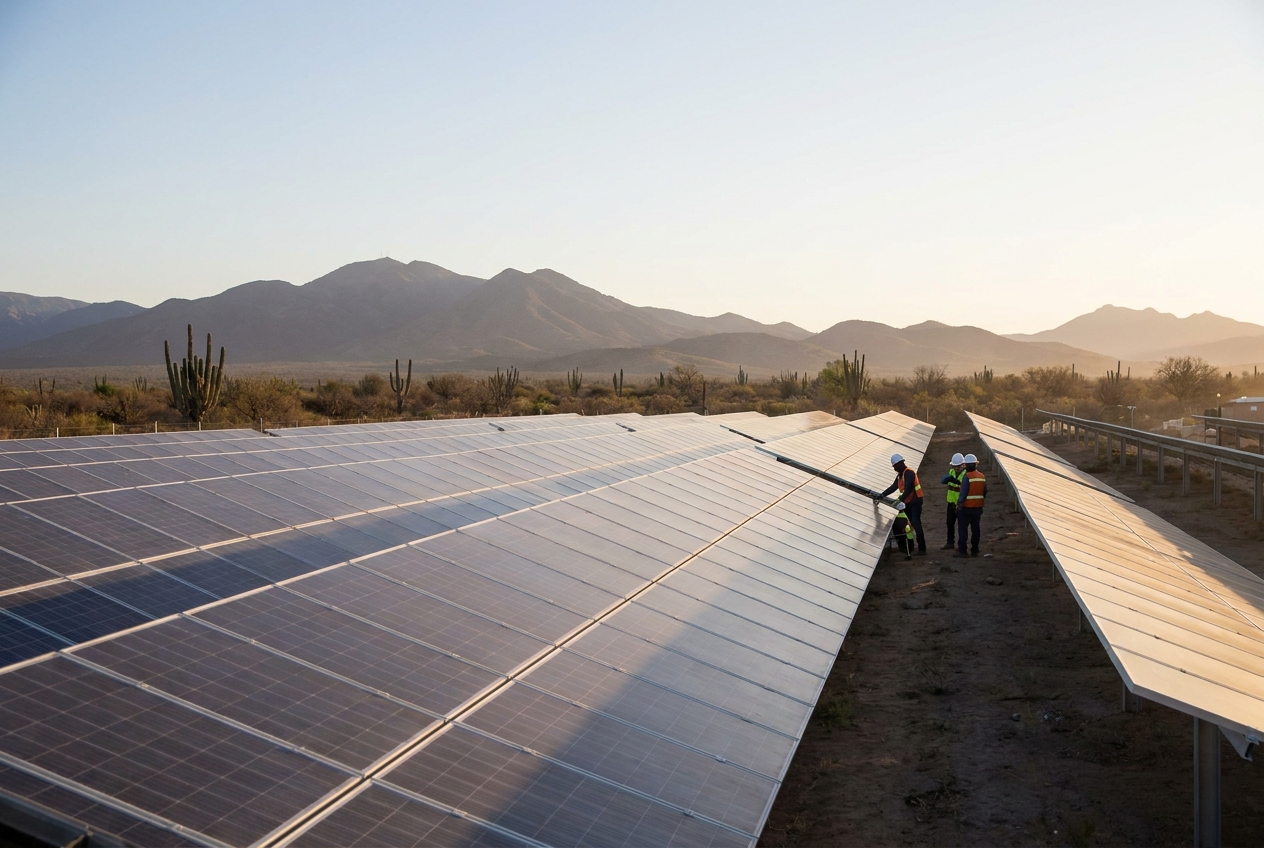
The global solar industry is at an inflection point. As the United States redefines its industrial policy amid a shifting domestic landscape and China consolidates its technological dominance across critical value chains, Mexico has a historic opportunity, not merely to integrate, but to lead.
A new legal framework and a renewed vision for energy development give Mexico the foundation to leap from manufacturing platform to industrial, innovative, and strategic powerhouse in solar energy, with direct benefits for our economy, our sovereignty, and the shared North American project.
This is not only a technical moment. It is a political and civilizational one. The energy transition is also a transition of power.
The Energy Reform as a Catalyst for Change
In Mexico, the recent legislative harmonization in energy matters has laid the groundwork for a new kind of industrial leadership. The reforms, including the Energy Planning and Transition Law (LPTE) and the new Electric Service Law (LSE), do something deeper than redefining institutional roles: they redefine the state's role as the orchestrator of an innovation ecosystem with a social and productive purpose.
This regulatory framework enables:
1. Building value chains with national content and a regional vision,
2. Promoting mixed investment schemes that attract capital without surrendering sovereignty,
3. Establishing Polos de Bienestar as industrial clusters with a solar vocation,
4. Streamlining and prioritizing distributed generation, self-consumption, and cogeneration,
5. Placing energy justice as a guiding principle of planning and public policy.
This is not just energy policy. It is industrial, social, and continental integration policy.
From Manufacturing Platform to Solar Power with Its Own Voice
Mexico has been a reliable manufacturing partner for the world for decades. Today, however, history offers a new narrative: the possibility of moving from "Made in Mexico" to "Made by Mexico."
The distinction is profound. This is no longer about simply assembling solar panels using someone else's technology. It is about:
1. Developing R&D centers for materials and storage,
2. Designing technology adapted to our own climatic and social conditions,
3. Building factories with local supply chains,
4. Generating Mexican patents, talent, and intellectual property,
5. Exporting integrated solutions from Mexico to the world.
The new legal framework allows, for example, distributed generation surpluses to feed into the public grid, for CFE to acquire solar projects at the end of their contracts, and for streamlined permit access for micro-productive projects in rural communities.
All of this builds a value-added logic in which Mexico does not merely participate: it proposes, regulates, and leads.
One SUN for North America: A Shared Vision
It is important to note that the reshaping of solar policy in the United States, including recent discussions about tax incentives and domestic production, follows its own democratic and industrial logic and must be understood as part of its sovereign process.
But that process also opens a window of opportunity for Mexico to complement and strengthen the North American energy architecture from the south.
As the U.S. reinforces its domestic supply chains, Mexico can offer an aligned, reliable, and strategic industrial platform, one that does not compete with U.S. objectives but amplifies them. We already do this in sectors such as automotive, electronics, and semiconductors.
Now it is energy and solar policy's turn, with a scope well beyond sustainability alone.
A robust regional system requires:
1. Diversification of industrial capabilities,
2. Regulatory coordination,
3. Mobility of technical and scientific talent,
4. Shared and resilient infrastructure.
All of this can be built if Mexico takes an active stance, not a subordinate one but a complementary one, as the leader of its own energy transformation.
Honoring My Mentor Sam Pitroda: Sovereignty with Cooperation
This commitment to sovereign solar energy is also inspired by the thinking of Sam Pitroda, who, through his experience leading India's technology revolution, articulated a profound principle: "build together to grow together."
From that perspective, Mexico must find ways to capture foreign investment, with state support, to benefit Mexican entrepreneurs. It must set the terms from its own development vision and create conditions under which technological, commercial, and financial partnerships are forged on the basis of mutual respect and shared ambition.
A Mexico-United States energy alliance need not be a triangle of tension. It can be a co-development model, provided Mexico occupies its place with clarity of purpose and well-defined rules of engagement. We must understand that the primary alliance is Mexico-USA-Canada, and only then do we address how we engage with the rest.
The Table Is Set
With the energy reform as a platform and the international moment as a favorable backdrop, Mexico can act immediately. We need to move beyond showcasing assembly plants and toward genuine component manufacturing, through:
1. A solar industrialization program in Polos de Bienestar, focused on assembly, electronics, batteries, and structures.
2. Sovereign green bonds focused on national solar value chains.
3. A national solar innovation system coordinated among CONACYT, universities, and SENER.
4. Co-investment mechanisms with foreign companies under Mexican rules, with national content requirements and technology transfer.
5. A community solar electrification program, leveraged with multilateral financing and the Universal Energy Service Fund.
The Energy Is Ours
The industrial history of the 21st century will be written with batteries, panels, smart grids, and bold decisions.
Solar energy is no longer just a clean option. It is a platform for economic sovereignty, territorial cohesion, and international leadership.
The new legal framework gives us the tools. The international context gives us the opportunity. What remains is the will.
From "Made in Mexico" to "Made by Mexico" is not a technical leap. It is a political decision.
And that decision can transform Mexico into the Sun of North America.
Frequently Asked Questions
What does Mexico's new energy reform change for the solar sector?
The Energy Planning and Transition Law (LPTE) and the new Electric Service Law (LSE) redefine the state's role as the orchestrator of an innovation ecosystem, enabling national-content value chains, mixed investment schemes, solar-focused industrial clusters (Polos de Bienestar), and energy justice as a core planning principle.
What is the difference between 'Made in Mexico' and 'Made by Mexico'?
'Made in Mexico' describes the assembly of components designed and owned elsewhere. 'Made by Mexico' means developing domestic R&D, intellectual property, and local supply chains, then exporting integrated solar solutions. The new legal framework creates the regulatory conditions for that shift.
How does Mexico's solar ambition fit into the North American energy landscape?
As the U.S. strengthens its domestic supply chains, Mexico can serve as a complementary industrial platform aligned with U.S. objectives rather than competing with them. The model already works in automotive and electronics and can be replicated in solar energy.
What are the five immediate policy actions recommended for Mexico's solar sector?
A solar industrialization program in Polos de Bienestar; sovereign green bonds for solar value chains; a national solar innovation system coordinating CONACYT, universities, and SENER; co-investment mechanisms with technology transfer requirements; and a community solar electrification program backed by multilateral financing.